We have an espalier apple tree that grows along the fence next to our pool. It doesn't take up much room and provides us with 2-3 buckets of apples each year. There are 6 limbs, each with a different variety of apple. I have since forgotten what kind we have! It has taken me a while to adjust to being an apple "farmer". To me, apples signify the start of fall. When the apples started falling in July I thought I had a problem with my tree. No, in our warm valley, they just ripen earlier! My granddaughter and I picked apples and I've been dealing with them ever since!

I'm just not in the mood to bake apple desserts yet, the smell of cinnamon is for fall, not summer! I did make some apple pie filling but still have a large bowl of apples in the fridge. Every time I open the door I feel guilty knowing I should be doing something with them. In the meantime, I keep being gifted summer fruits (thank you all my gifters!) and was given a nice bag of plums. The same day this happened I received a free Family Circle magazine in the mail. One of their recipes was for this apple-plum cobbler. It was a divine inspiration moment, a way to use both fruits! It was easy to decide on dessert that night!
The plums really shine in this cobbler, it has a nice sweet-tart vibe to it. The addition of sour cream to the biscuit dough made for a very light and fluffy cobbler biscuit. This will be my go-to cobbler biscuit recipe from now on.
Skillet Apple-Plum Cobbler
Fruit:
1 1/2 pounds apples, peeled and sliced 1/4 inch thick
1 1/2 pounds plums, peeled and sliced 1/4 inch thick
1/2 cup sugar
1/4 cup all-purpose flour
2 tablespoons lemon juice
1/8 teaspoon salt
Biscuits:
1 cup all-purpose flour
1/4 cup sugar
1 teaspoon baking powder
1/4 teaspoon baking soda
1/4 teaspoon salt
4 tablespoons cold unsalted butter, cubed
1/2 cup sour cream
1 tablespoon turbinado sugar
Heat oven to 400 degrees.
Carefully combine all fruit ingredients. Place in a 12-inch cast-iron skillet and bake for 30 minutes.
Meanwhile, whisk first five biscuit ingredients together. Using pastry blender, or hands, add butter until clumps the size of peas are formed. Stir in sour cream. Form into 6 round biscuits.
Carefully remove skillet from oven and place biscuits on top. Sprinkle with turbinado sugar. Bake 20 minutes more, until biscuits are browned.
In the late 1920s, George M. Darrow of the USDA began tracking down reports of a large, reddish-purple berry that had been grown on the northern California farm of a man named Rudolph Boysen. Darrow enlisted the help of Walter Knott, a Southern California farmer who was known as a berry expert. Knott had never heard of the new berry, but he agreed to help Darrow in his search. Darrow and Knott learned that Boysen had abandoned his growing experiments several years earlier and sold his farm. Undaunted by this news, Darrow and Knott headed out to Boysen's old farm, on which they found several frail vines surviving in a field choked with weeds. They transplanted the vines to Knott's farm in Buena Park, California, where he nurtured them back to fruit-bearing health. Walter Knott was the first to commercially cultivate the berry in southern California. He began selling the berries at his farm stand in 1932 and soon noticed that people kept returning to buy the large, tasty berries. When asked what they were called, Knott said, "Boysenberries," after their originator. His family's small restaurant and pie business eventually grew into Knott's Berry Farm. As the berry's popularity grew, Mrs. Knott began making preserves, which ultimately made Knott's Berry Farm famous ( culinary history lesson from Wikipedia).
In the 1950's there were over 2,400 acres of boysenberries in California. With its short season (4-6 weeks) and labor-intensive production now they can mostly be found at farm stands, where the farmer may have an acre or two in production. Luckily for me, one such stand exists in my town. This morning I drove across town and picked up a flat. The majority made it in to my kitchen but I did eat quite a few on the way home. They are sooooo good!
First on the agenda was a batch of boysenberry jam. A jar of this will soon make its way into a batch of berry bars!
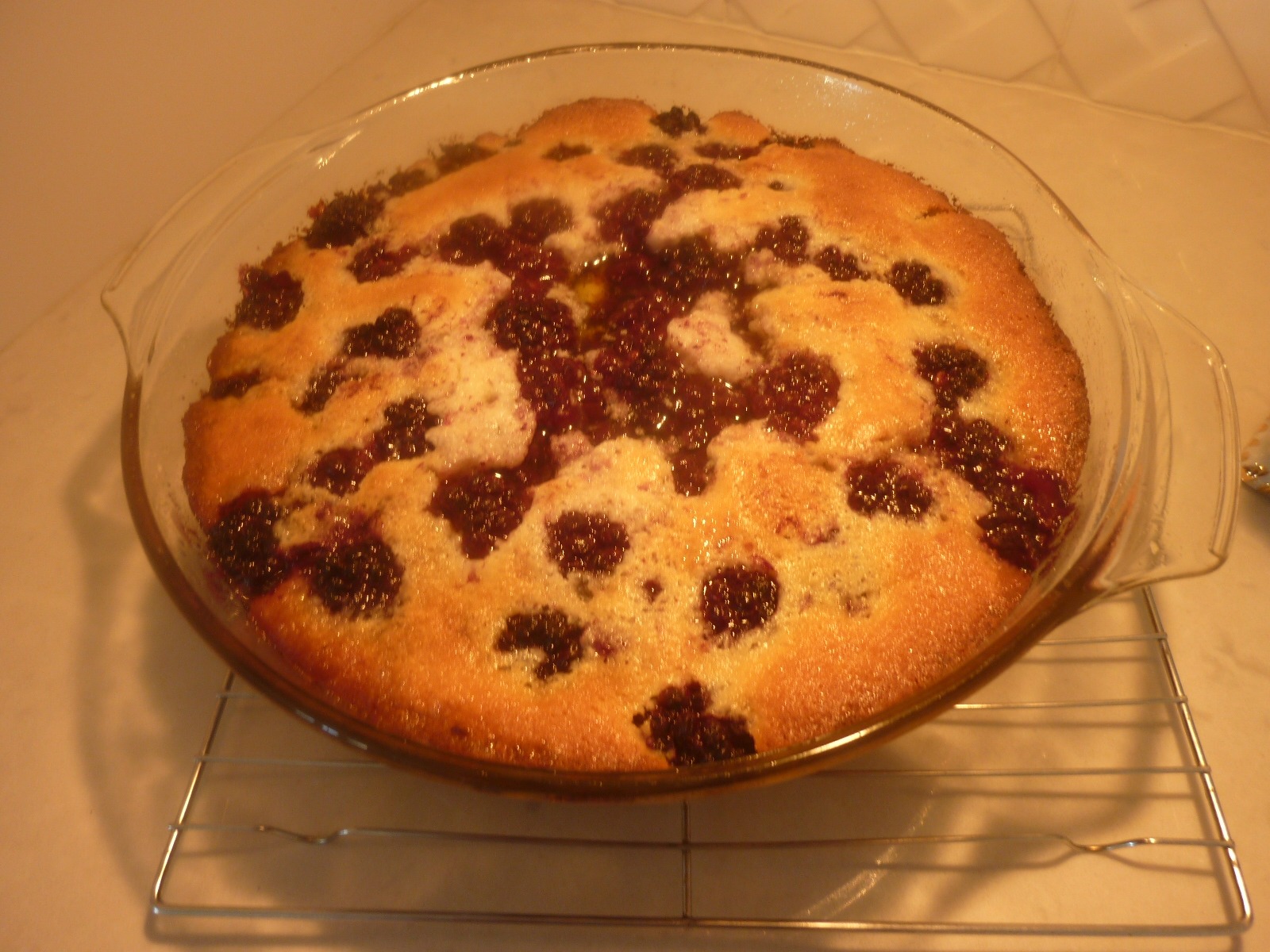
A berry cobbler was next. This is a very basic cobbler recipe that Grandma McGee always made. Any kind of fruit can be used but I've always been partial to berry cobbler. I've not made one in years but my sister made one a week or so ago and posted a picture on her Facebook page. I've been craving this cobbler ever since! Sometimes the easiest and oldest recipes are the best!
Nettie's Fruit or Berry Cobbler
1 cube (1/2 cup) butter
1 cup sugar
1 cup flour
1 teaspoon baking powder
1 cup milk
1 quart (4 cups) fruit (cut up) or berries, with their juice
Preheat oven to 350.
In a 3 quart baking dish, pleace butter and put into oven to melt.
Meanwhile, in a mixing bowl, blend together the sugar, flour, baking powder & milk.
When butter is melted, remove dish from oven and quickly stir batter into the butter, stirring until no butter streaks remain. Spoon the fruit or berries on top of the batter, distributing evenly. DO NOT STIR.
Return to oven and bake for 50-60 minutes, until golden brown and fruit is bubbly.
I froze four baskets of the berries for another day. I distribute them (unwashed) on a baking sheet and freeze for about 20
minutes. Once frozen I transfer to a ziploc bag. By not washing them the berries stay whole and don't stick together. It's easy to pull out some for a smoothie or to use in other recipes. Don't forget to wash them before using, though!
I kept a few berries aside to make a drink for my hubby and I to have around the pool. I'm a big fan of mojitos. It's been suggested that the sole purpose of my mint plant is to feed my mojito habit!
Today I adapted my go-to mojito recipe to include boysenberries. They were quite refreshing!
Boysenberry Mojito
10-12 fresh mint leaves
4 ripe boysenberries
Juice of 1 lime
1 ½ ounces simple syrup, or 2-3 tablespoons ultrafine sugar
2 ounces Bacardi Limon rum
Soda water
Lime wedge and spring of mint for garnish
Put the mint in a pint glass, then add the lime juice and simple syrup. Gently mash with the handle of a wooden spoon or a muddler until the mint begins to bruise and its essence rises from the glass. Add boysenberries, gently muddle until juice is released. Put ice in the glass. Add the rum, then fill with soda water. Stir with a long spoon, lifting the mint so it disperses throughout the drink. Garnish.
Alternate method (the way I make them, I don't like bits of mint floating in my drink!): Do the muddling in a cocktail shaker, strain, pour into glass and add soda water.
Hope your weekend was great! Please join me at On the Menu Monday for more wonderful recipes!


.JPG)